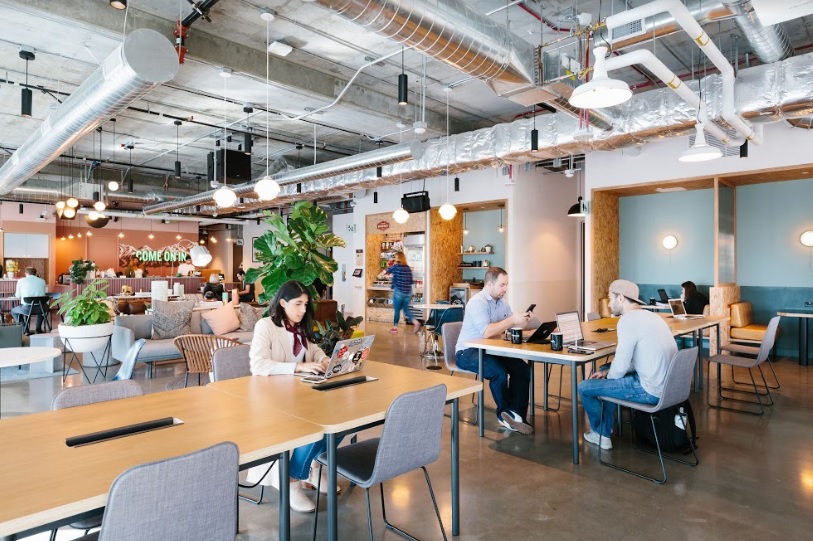
Source: WeWork.

Until fifteen years ago it seemed impossible to combine the concepts of freedom and independence that value people who want to take their own path with the advantages offered by the structure and community of corporate enterprises.
The idea of a community of people united in the same physical space in order to increase productivity, promote innovation and achieve a more human experience within the workplace was gaining followers from its genesis to the present day.
The real estate sector, structured on the hunt for new opportunities, detected that it could rent a property at a price and transform this product into another concept beyond the property itself achieving very attractive income, diversifying the risk, shortening the lease contract periods and obtaining higher unit incomes where a significant proportion of this corresponds to the services and not to the property itself. These changes in supply were preceded by changes in demand paradigms associated with the millennial era and underpinned by the penetration of technology in all areas of life.
In that race to seize the opportunity in the big cities of the world and try to implement this trend in Mexico, foreign companies such as Wework, Regus and Spaces, together with Mexican capital groups such as IOS offices and IZA Business Centers, managed to consolidate in the country as the leading companies that provide spaces with these characteristics.
All these companies offer a range of diverse possibilities, some of them pointing to a more corporate concept and others combining the coexistence of smaller companies and independent professionals, where again technology is the main pivot to promote the integration of these communities.
Currently, the corporate market in Mexico City has an inventory of class A offices totaling 6.8 million m², according to data from the 3Q 2019 report of Solili, making it the largest corporate market in the country. The market is mostly dominated by traditional corporate spaces occupied by private companies and government agencies, however, in recent years the corporate demand that are destined to be coworking spaces has been increasing. At the end of September, Solili reports that there are a total of 313 thousand m² of class A spaces in Mexico City of coworking spaces, representing 4.6% of the total inventory of class A spaces in Mexico City.
Source: Solili, October 2019.

The geographical location of the coworking spaces over Mexico City shows a 65% concentration on the Reforma, Insurgentes and Polanco corridors, areas where 44% of the Class A inventory of Mexico City is concentrated. The largest amount is placed on the Insurgentes corridor exceeding 73 thousand m², representing 7% of the total inventory of that corridor.
Interlomas does not stand out for the size of its total corporate class A inventory in Mexico City, since it is one of the smallest, it has only 117 thousand ² total, however, it is in this corridor where the highest percentage is concentrated relative of coworking spaces, reaching 12% of the total inventory.
Graph 1: Coworking spaces as a percentage of the total class A inventory of Mexico City.
Source: Solili, October 2019.

The central business district (CBD) of Mexico City, which is made up of Reforma and Polanco, is the favorite of coworking companies to establish their spaces, however, in the last three years the Insurgentes corridor is the one that has concentrated the highest demand by coworking companies, which total almost 74 thousand m² and represents 24% of the total coworking spaces in the city. The fact that the Insurgentes corridor is currently the one that represents the highest volume of spaces of this type is due to the fact that it is a corridor where in recent years the supply of new spaces has exploded because it has infrastructure, diversified turn companies, Average prices lower than CBD brokers and sustained corporate demand.
Unlike the aforementioned, the Lomas Altas corridor does not have coworking spaces (by the main 5 companies mentioned above) in class A buildings, thus seeing an area of opportunity for companies that offer spaces of this nature to settle in this corridor.
The diversified offer of spaces in terms of location, amenities, internal services, infrastructure, business transfers, among others have determined that companies have expansion plans that allow them to capture a greater demand. In this context, the main companies in question (Regus, Spaces, IOS offices, IZA Business Centers and WeWork) have sought to have a presence around the city and attract customers looking for these types of spaces and with specific characteristics.
Currently, the company with the highest number of coworking spaces in Mexico City in class A buildings is WeWork, which concentrates 65% of the total, established in 18 buildings in the city. The remaining 35% is concentrated by the remaining 4 companies.
Graph 2: Distribution of the offer of class A coworking spaces by company in Mexico City.
Source: Solili, October 2019.

The main competitors in Mexico City attack different market niches but they have similar characteristics in the background, hence each company has sought to define itself by looking for differentiating elements each.
In the case of WeWork, it offers the combination of physical and virtual spaces, mixing multiple business services that favor networking within their communities. Their options are from spaces with a highly corporate tendency to more creative and informal formats, where their users manage to blur that marked line that existed between personal and work life. On the other hand, Regus and Spaces, companies of the IWG group, offer a range of services ranging from office spaces, boardrooms, coworking, memberships, to virtual offices in their spaces that allow interaction between their members, however, they have A corporate trend. IOS offices is described as a company where its spaces have six advantages, which are mobility, networking, happiness, productivity, technology and savings, while IZA Business Centers, offers private offices, team room and suites all with the format of equipped offices.
Source: WeWork

The immediate future allows us to see a growth of these types of spaces in the inventory of Mexico City, motivated by the maturation of multiple startups that manage to position their concepts and the growing demand for this type of spaces as observed in the Mexican market with various corporate, citing the cases of Lala, Santander and Microsoft, among others. The global trend that aims to favor flexible work is another unstoppable element in the world that consolidates a transformation in demand that in turn will challenge investors and developers generating an increasingly innovative offer.
In this context, the corporate demand of Mexico City by companies that allocate space to coworking has been growing steadily in the last three years. In 2017, the demand for coworking was 47 thousand m², of which 28% was concentrated by the Reformation corridor, followed by Periférico Sur with 25%. Approximately 90% of this demand was concentrated by the WeWork company. For 2018, the growth rate of the demand for coworkings in Mexico City was 7% compared to the previous year, and it was characterized as being the Insurgentes Sur corridor that concentrated around 45% of the total demand.
Coworking is driving the demand of the main corporate centers in the country, specifically in Mexico City. If we analyze the gross demand figures for the third quarter of this year, for class A spaces, we have that the demand for coworkings represented approximately 24% of the total demand.
Graph 3: Gross demand for class A office spaces of coworking companies in Mexico City.
Source: Solili, October 2019

Until the third quarter of this year, the demand for corporate spaces by coworking grew 45% compared to the previous year and 55% compared to 2017. The demand that is reported so far this year has been characterized because coworking is leasing larger spaces and in some cases, complete buildings. WeWork has been the main applicant for corporate space until 2019.
The corridors that concentrate most of the demand until September 2019 are Polanco with 25% and Insurgentes with 24%, followed by Reformation with 20%, that is, the trend remains as the CBD brokers of the City from Mexico and Insurgentes, those that capture the highest demand and consequently where coworking companies look for more spaces to lease.
In conclusion, it could be said that despite the circumstances of the model in the international arena, Mexico City seems to lean towards a growing demand scenario, where more and more companies that used to cover the traditional supply will join this concept.
Stay up to date with the most important news to the real estate
Subscribe Solili Newsletter