There is no doubt that the pandemic has significantly hit the commercial real estate industry and specifically the office segment that, in compliance with the provisions outlined by the federal government, halted construction works during the months of April and May 2020, resuming operations at Starting in June, which resulted in a significant slowdown in the construction rate. The administrative tasks, in parallel, operated under the remote work scheme, respecting the policy of confinement and trying to rescue productivity prior to the coronavirus pandemic.
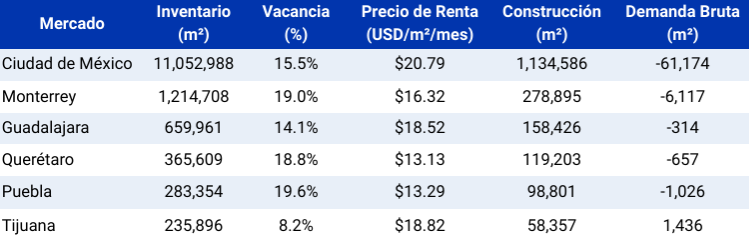
Table 1: Indicators of the Office Real Estate Market in the Second Quarter of 2020 in the Main Markets of Mexico.
Source: Solili, July 2020.
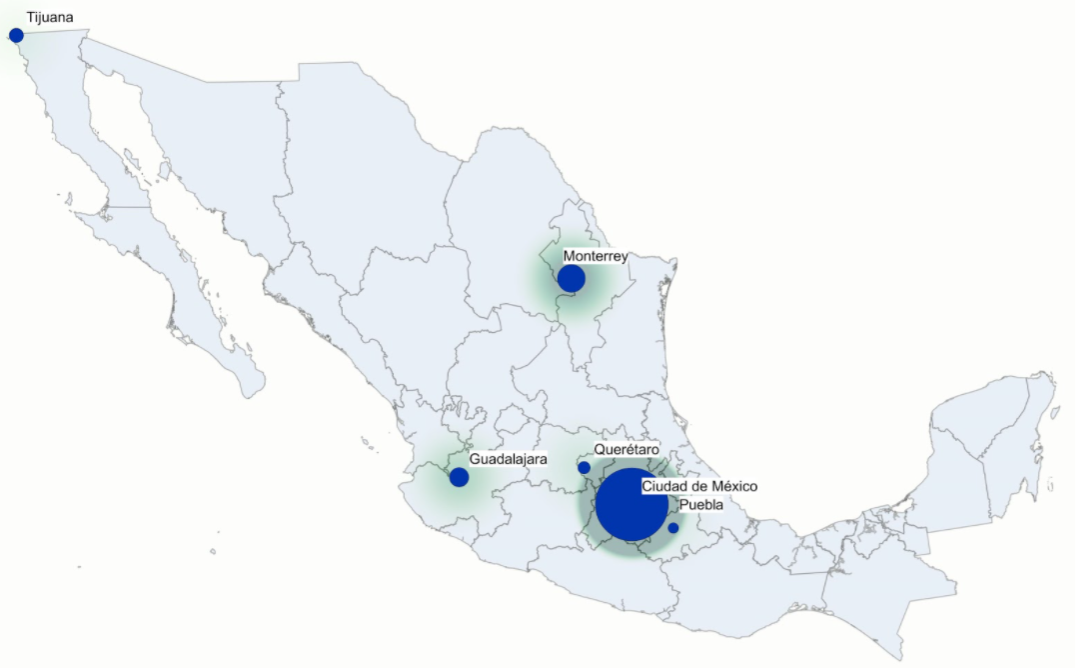
At the end of the second quarter, the main cities of the country reflected a slight increase in their office inventories, showing well below the average growth that had been observed. Querétaro increased its inventory by 2.6% with the delivery of a building that enters the market fully available, also in Tijuana another building on the Rio Zone reflects the 1% increase in its inventory, closing with Puebla that incorporates a Class A building into the city 2,000 m². Guadalajara and Monterrey stopped the delivery of corporate buildings without reporting any construction term in the quarter, while in Mexico City before the pandemic, it was planned to deliver almost 100,000 m2 during the period April-June 2020 and it was only added to inventory 9% of the projected. The delay in declaring construction as an essential activity, the uncertainty that permeates investors before such a panorama and the incorporation of protocols to maintain a healthy distance contributed to the brake on this sector, which had always represented a multiplier effect on the economy.
In terms of vacancy, the main national office markets monitored by Solili, at the end of June 2020, reported oversupply, confirmed with the increases that this indicator showed during the second quarter of 2020. Mexico City, which is where 80% of the inventory is concentrated nationwide, it exceeds 1.7 million m² of vacant spaces, 65% corresponding to Class A buildings and 67% of this vacancy is concentrated on the North, Insurgentes, Reforma and Santa Fé sub-markets. The largest vacancy increases with respect to the size of their markets were registered in Querétaro and Puebla with 16% and 7% respectively, mainly motivated by the vacancies that in the case of Puebla were reported on the Angelópolis and Centro-Juárez sub-markets. Monterrey with a 19% vacancy increased this indicator by 30 basis points compared to the previous quarter, accentuating the oversupply that this market has been exposing for two years. However, the markets of Guadalajara and Tijuana slightly decreased their vacancy, despite this, Guadalajara, the third largest in size nationwide, continues with oversupply levels, while Tijuana is the only market with healthy vacancy rates. which is around 8%.
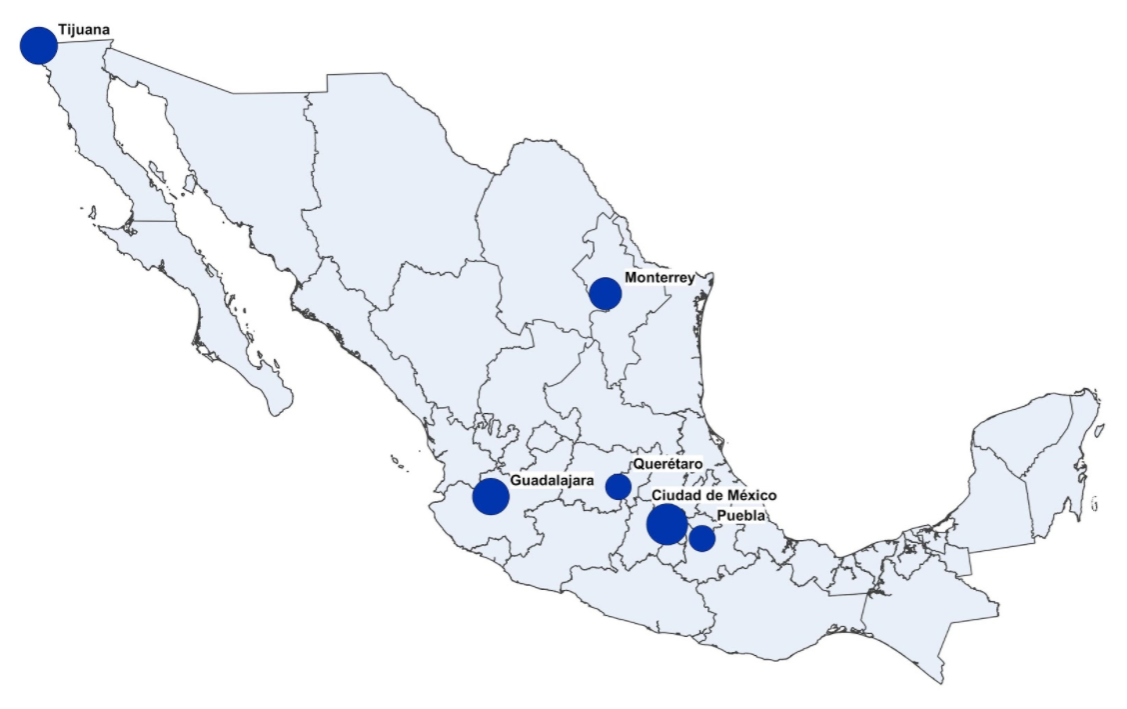
Map 1: Office Rental Prices in the Main Markets of Mexico.
Source: Solili, July 2020.
Another phenomenon observed is the rent prices adjusted upwards with respect to the previous quarter in most cities, this being the result of the appreciation of the local currency against the dollar and not motivated by the deliberate increase of the developers in the prices of the office spaces.
However, if the analysis is carried out in annual terms, all markets, with the exception of Tijuana, reflect downward adjustments, the most pronounced being Monterrey, Guadalajara and Querétaro with 19%, 11% and 10%, respectively. Mexico City and Puebla in quarterly comparison reflect an increase of 2.2% and 4%, while in annual comparison they indicate an opposite trend marked by the contraction of the average rental price of 5% and 3%, respectively. The high volumes of vacancy reported by most markets are starting to generate pressure on prices, hence the owners began to take measures in the face of this to make their spaces more competitive and become attractive in the face of a demand that is increasingly constrained . Tijuana is the only city that shows a slight increase in its rental price of 5 cents on the first quarter of the year and 2% in annual terms, being one of the least affected markets in the pandemic. Therefore, given the pressure that vacancy rates are generating in most office markets in the medium-term horizon, a downward trend in rental prices can be projected.
Map 2: Construction of Offices in the Main Markets of Mexico.
Source: Solili, July 2020.
Despite the adverse conditions that this real estate segment exposes, during the period April-June 2020 in Tijuana the start of a new corporate project of 4.4 thousand m² of net profitable area, located on the Agua Caliente sub-market and that estimates its delivery, was announced. in the year 2022. The trend observed is to keep the projects in the planning phase until the economic conditions for their start-up are in place, while those in execution will continue at the speed defined by the cash flow of income and negotiations of the financing schemes in the framework of monitoring the new operating protocols in force.
Gross demand for offices, the main trigger for the market, was severely affected by the measures taken to spread the coronavirus pandemic. According to Solili data, most of the office markets nationwide reported negative scenarios in this indicator, Querétaro reported a quarterly contraction of 91%, Guadalajara 86%, 61% in Mexico City, 58% in Monterrey and 46% in Puebla. Tijuana reflected the least impact with a 29% contraction. The application of the home office that the companies implemented from April 2020 allowed companies to rationalize costs, continue operating in basic conditions in order to maintain the health of workers.
Graph 1: Historical Net Demand for Offices by Main Markets in Mexico (m²).

Source: Solili, July 2020.
In markets such as Mexico City, this indicator reported a negative figure of 61 thousand m², which highlights the contraction in demand, but also the move outs reported by the market, from companies that reduced space and other who terminated contracts. Tijuana was one of the few cities that maintained a positive net demand of 1.4 thousand m², 22% higher than that registered in 2Q 2019.
The general perception of developers at the national level, according to the survey prepared by Solili to the main marketers of office space in the country, at the end of 2Q 2020 makes them foresee rents adjusting downward, availability increasing under a scenario where construction continues before a precautionary scenario determined by a lawsuit that shows signs of recovering slightly towards the end of 2020.
Mexico and its main cities have the potential to circumvent this recomposition of the commercial flow worldwide, where the institutional legal framework, the confluence of multiple local and foreign developers are factors in favor that must seek the implementation of clear policies by the federal government. to generate the confidence of corporate investors towards our country.
The pandemic arrived to generate a new order in the way of operating in office spaces where a greater surface area per employee is established, innovation in technology and connectivity in order to integrate equipment on-site and remotely, new arrangements and uses of spaces, inclusion of amenities and income in staggered hours in order to reduce the density of people and minimize the vertical flow of movement in buildings. Medium-term trends point to the use of flexible spaces to increase or decrease sizes and make departure times more flexible, which coworking will take advantage of in the coming quarters. Cities like Puebla and Querétaro will seek to benefit from corporate movements that decentralize operations from the capital, while Tijuana, Guadalajara and Monterrey have the challenge of adapting the projects in operation and validating that the spaces that are built and planned incorporate the requirements that dictates the new normal. At the capital level, maintaining and reinforcing the institutionality of the corporate sector while triggering demand momentum with key programs such as the development of projects on the Reforma sub-market, the urban regeneration of the center and the construction of new homes demand that the The public sector regulates with the necessary instruments for the private sector to execute where it has demonstrated expertise in recent years in a key sector for the economic reactivation of the capital.
Stay up to date with the most important news to the real estate
Subscribe Solili Newsletter